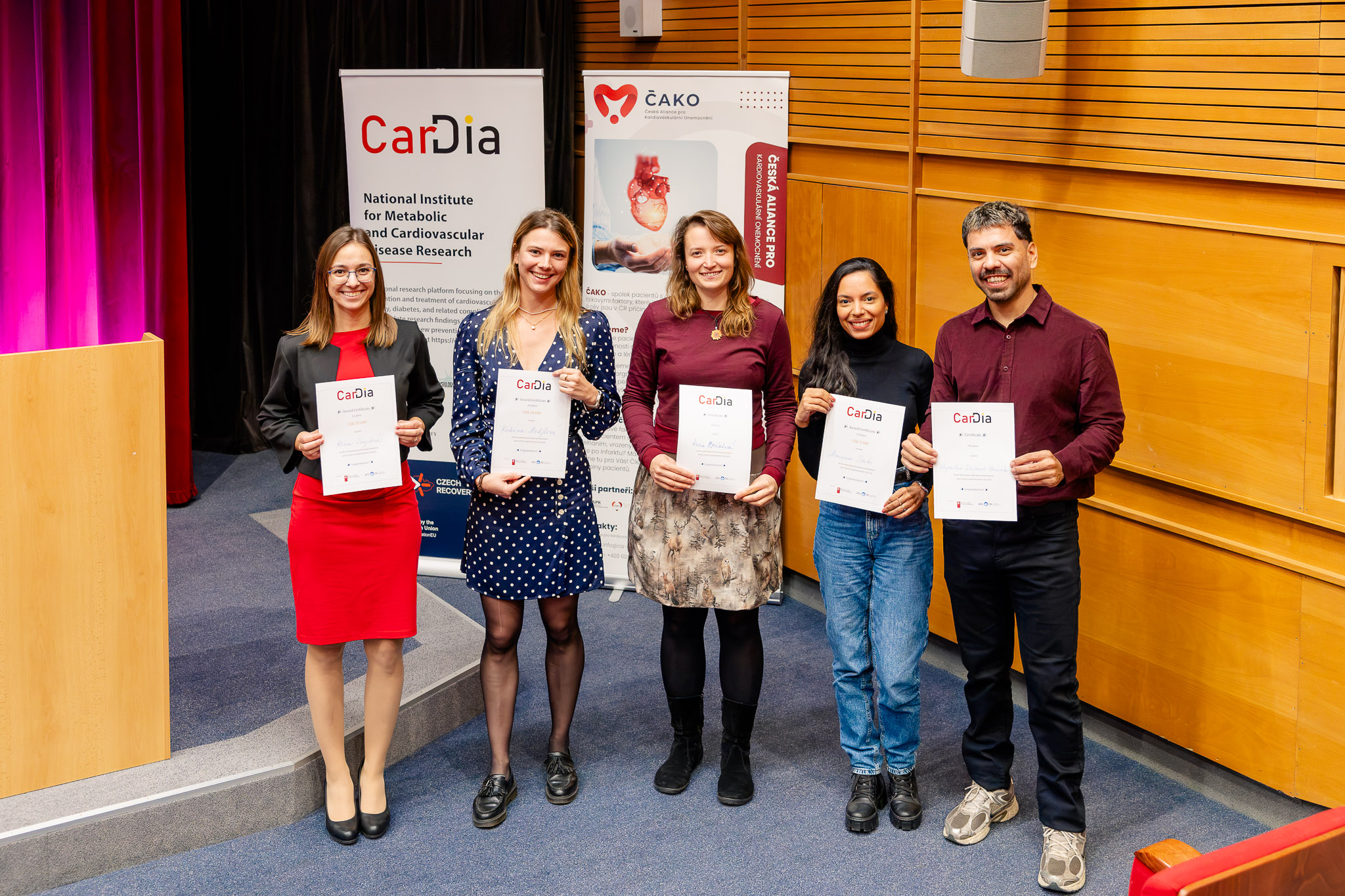
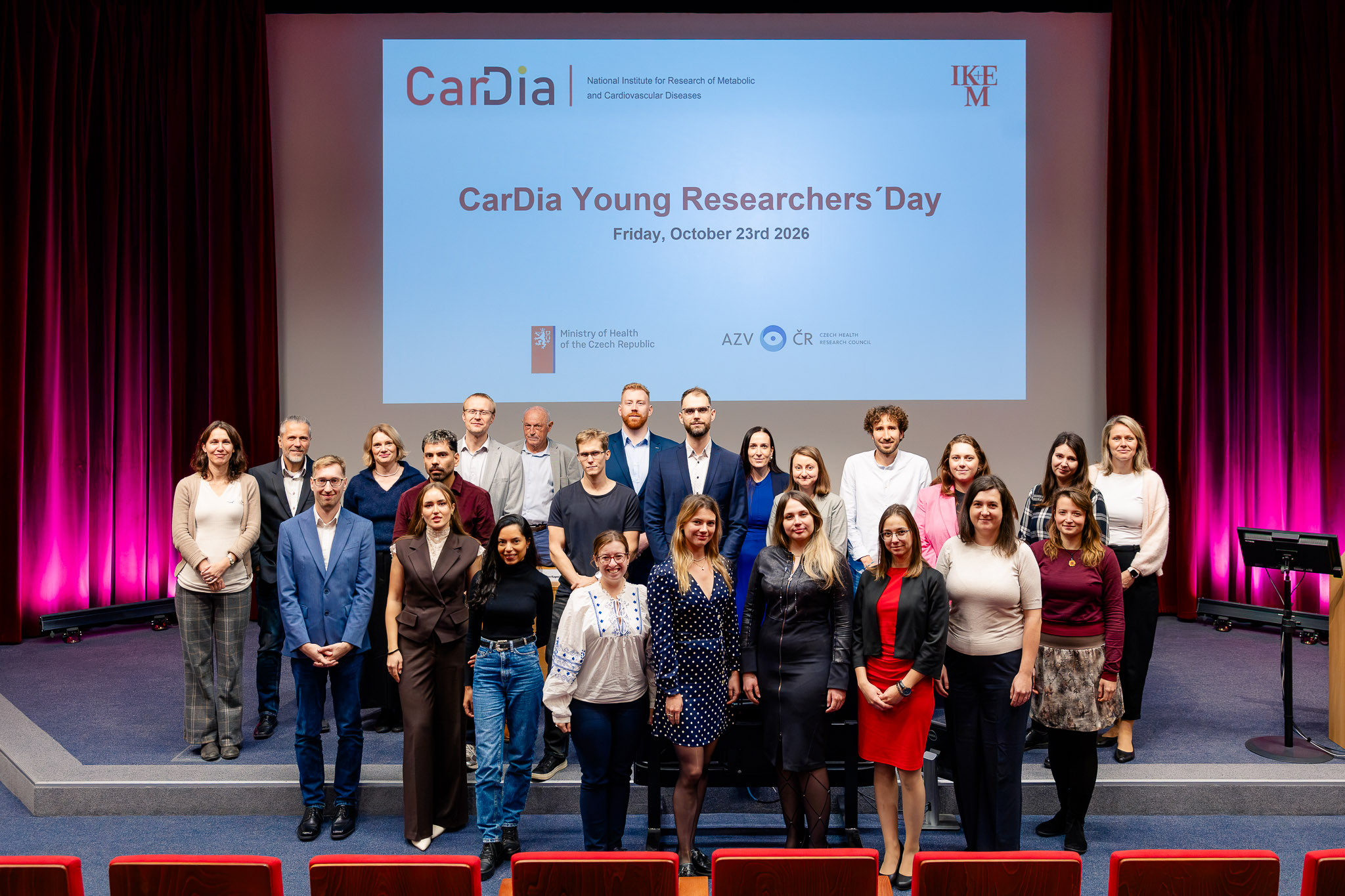
On Friday, October 23, CarDia Young Researchers’ Day 2026 took place in the IKEM Congress Hall. Young scientists and physicians from IKEM, the First and Third Faculties of Medicine at Charles University, Masaryk University, the Institute of Physiology of the Czech Academy of Sciences, and the Institute of Organic Chemistry and Biochemistry presented 18 lectures and 12 posters on topics ranging from mitochondrial genetics to a randomized study of bariatric surgeries. The jury was chaired by Assoc. Prof. Michal Dubský, M.D., Ph.D., MBA, LL.M., FRSPH (IKEM); other members included Lenka Rossmeislová, Ph.D. (Charles University), Mgr. Kristýna Čillíková (ČAKO), MUDr. Jan Kopecký, DrSc. (Geological Survey of the Czech Republic, Czech Academy of Sciences), RNDr. Jiří Jiráček, CSc. (Institute of Organic Chemistry and Biochemistry), and Mgr. Vladimír Rotrekl, Ph.D. (Masaryk University).
First place went to Ing. Klára Svojšová (1st Faculty of Medicine, Charles University), who placed second last year. Her team contributed to research on single-nucleotide insertions in the LSP2 promoter of mitochondrial DNA in nine unrelated families with hereditary tubulointerstitial kidney disease, the cause of which remains unknown in approximately 30% of cases. Fibroblasts from patients showed reduced mitochondrial translation and lower levels of coenzyme Q10. The study supports the use of mitochondrial DNA testing in unexplained cases, particularly when the condition is maternally inherited.
Second place went to Kateřina Matějková, M.A. (First Faculty of Medicine, Charles University) for the bioinformatics tool paRDal, which processes paired DNA and RNA sequencing data all the way through to clinical interpretation. Many variants of uncertain significance disrupt mRNA splicing, a phenomenon that can only be detected through RNA analysis. In individuals screened for a hereditary predisposition to tumors, RNA data helped classify most of these variants as either pathogenic or benign. The tool works for any gene and is therefore also applicable in cardiogenetics.
Third place went to M.Sc. Mariana Santos, Ph.D. (FGÚ AV ČR), who demonstrated in a mouse model of obesity that the enzyme NOX4 regulates bone healing differently in males and females. Female bone marrow stromal cells were resistant to glucose-induced oxidative stress, whereas male cells required NOX4 to maintain redox balance. The mechanism underlying the increased risk of fractures in obesity—and, consequently, a potential therapeutic target—may therefore differ by sex.
The CarDia National Institute would like to thank all the speakers, the jury, and the organizers. Research in the CarDia project is supported by the Ministry of Health of the Czech Republic in cooperation with the Czech Health Research Agency (project no. NW26A-CARDIA).





dana.hruskova@ikem.cz



dana.hruskova@ikem.cz
